
TH-658MA Automatic Cementing Side & Heel Seat Lasting Machine – Seamless Cementing with Precision Lasting Technology
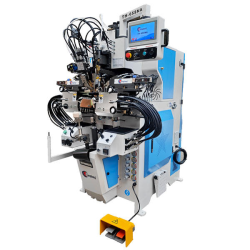
In the highly competitive footwear manufacturing industry, innovation and automation are key to achieving superior product quality, reducing labor costs, and meeting tight production schedules. The TH-658MA Automatic Cementing Side & Heel Seat Lasting Machine emerges as a game-changer for shoe manufacturers looking to modernize their production lines. This advanced machinery combines precision engineering with automation to deliver unparalleled efficiency and consistency in the lasting process. In this comprehensive blog, we will explore the features, benefits, working principles, and practical applications of the TH-658MA, shedding light on why it is an indispensable asset for shoe manufacturing businesses worldwide.
The Lasting Process in Shoe Manufacturing
The lasting process is a critical stage in footwear production, where the shoe upper is stretched and attached firmly to the insole and midsole, forming the shoe’s final shape. This process affects both the shoe’s aesthetics and functional integrity. Traditionally, lasting was performed manually, which was time-consuming and prone to inconsistencies, impacting product quality. Modern footwear manufacturing demands faster, more accurate, and repeatable processes. This need has led to the rise of automated lasting machines, such as the TH-658MA, which specialize in cementing side and heel seats with speed and precision.
Overview of the TH-658MA Automatic Cementing Side & Heel Seat Lasting Machine
The TH-658MA is an advanced automatic lasting machine designed specifically for cementing the side and heel seats of shoes. It integrates cutting-edge servo motor technology and intelligent control systems, enabling seamless automation of the lasting process. This machine is designed for medium to large-scale shoe factories seeking to optimize their production efficiency without compromising on quality. The TH-658MA automates critical steps such as cement application, lasting, and pressure application, significantly reducing manual intervention and human error.
Key Features and Technical Specifications
Understanding the features and specs of the TH-658MA helps in appreciating its impact on shoe production lines.
Features
-
Fully Automated Lasting Process: Integrates automated cementing, side and heel lasting with servo motor control.
-
High Precision Cement Application: Ensures uniform glue spreading for secure bonding.
-
Adjustable Lasting Parameters: Programmable lasting pressure, speed, and timing to accommodate different shoe styles and materials.
-
User-Friendly Touchscreen Interface: Simplifies operation with intuitive controls and monitoring.
-
Energy Efficient Design: Optimizes power consumption while maintaining high output.
-
Durable Construction: Made with high-grade materials to withstand continuous industrial use.
-
Safety Features: Includes emergency stop buttons, safety guards, and sensors to protect operators.
-
Compact Footprint: Designed to fit seamlessly into existing production lines without major layout changes.
How TH-658MA Enhances Production Efficiency
One of the biggest challenges in shoe manufacturing is balancing speed with quality. Manual lasting can be inconsistent and slow, causing production bottlenecks. The TH-658MA addresses these issues by:
-
Automating Cement Application: Uniform glue application prevents material waste and ensures better bonding.
-
Reducing Labor Dependency: Operators can manage multiple machines simultaneously, reducing workforce requirements.
-
Consistent Lasting Pressure: Programmable pressure avoids damage to shoe components and maintains structural integrity.
-
Faster Cycle Times: The machine achieves up to 25 shoes per minute, enabling high throughput.
-
Minimizing Errors: Digital controls reduce the likelihood of operator mistakes.
-
Quick Changeover: Adjustable settings allow fast switching between different shoe models, reducing downtime.
Quality and Precision: The TH-658MA Advantage
The lasting process is vital for shoe durability and comfort. TH-658MA enhances product quality by:
-
Accurate Glue Spreading: Controlled cementing prevents glue overflow and weak spots.
-
Even Pressure Distribution: Ensures that side and heel seats are perfectly secured without wrinkles or deformities.
-
Customizable Settings: Tailors operations to the specific shoe materials such as leather, synthetic, or textile uppers.
-
Stable Mechanical Components: The robust build maintains accuracy even after long hours of continuous use.
-
Integrated Quality Checks: Sensors detect misalignment or glue absence to prompt immediate correction.
The result is a finished shoe that not only looks professional but also performs well under wear and tear.
Installation, Operation, and Maintenance Guidelines
Proper setup and upkeep of the TH-658MA are essential for optimal performance.
Installation
-
Place the machine on a level, sturdy floor.
-
Connect to the appropriate power supply and air compressor if required.
-
Calibrate the machine based on shoe sizes and materials.
-
Train operators on touchscreen controls and safety protocols.
Operation
-
Load shoe uppers and insoles as per the production schedule.
-
Set parameters for cementing pressure, timing, and lasting speed.
-
Monitor the operation via touchscreen HMI.
-
Conduct periodic quality checks on output products.
-
Use emergency stop buttons if any abnormality occurs.
Maintenance
-
Daily cleaning of glue applicators and lasting heads to avoid clogging.
-
Regular lubrication of moving parts.
-
Inspect electrical components for wear or damage.
-
Schedule periodic professional servicing to maintain precision.
Following these guidelines will extend machine life and reduce downtime.
Real-World Applications and Customer Success Stories
Many shoe manufacturers worldwide have integrated the TH-658MA into their production lines with remarkable results.
Boosting Output for a Sports Shoe Manufacturer
A mid-sized sports shoe factory increased production by 40% after installing the TH-658MA. The machine’s automation reduced labor costs and improved lasting uniformity, leading to fewer product defects and higher customer satisfaction.
Enhancing Quality for a Formal Footwear Brand
A luxury formal shoe brand adopted the TH-658MA to maintain consistent heel and side seat lasting. The machine’s precise glue application preserved delicate leather surfaces and enhanced shoe durability, strengthening the brand’s reputation.
Environmental and Economic Benefits
Using the TH-658MA promotes sustainability and cost savings:
-
Reduced Material Waste: Precise glue application cuts down excess usage.
-
Energy Efficiency: Servo motors and optimized controls minimize power consumption.
-
Lower Labor Costs: Automation reduces the need for extensive manual labor.
-
Higher Yield: Fewer defects translate to less scrap and rework.
-
Longer Machine Lifespan: Durable design reduces the need for replacements.
Factories adopting TH-658MA benefit both economically and environmentally.
Is the TH-658MA Right for Your Business?
The TH-658MA Automatic Cementing Side & Heel Seat Lasting Machine stands out as a robust, efficient, and precise solution for modern footwear manufacturers. By automating the critical lasting process, it reduces production costs, improves product quality, and accelerates output, essential factors for staying competitive in today's global market.
Contact Maxinarytech.com Today!
Explore more about the TH-668MA and other footwear machinery by visiting maxinarytech.com. Our expert team is ready to assist you with product selection, technical consultation, and after-sales support to ensure your factory’s success.
FAQ for TH-658MA Automatic Cementing Side & Heel Seat Lasting Machine
What is the main function of the TH-658MA machine?
The TH-658MA is designed to automatically perform side and heel seat lasting operations with integrated cementing. It applies adhesive to the shoe upper and firmly presses it onto the last, ensuring a secure and accurate fit.
What makes the TH-658MA different from non-cementing models?
Unlike non-cementing models, the TH-658MA features an automatic glue application system that ensures even and consistent adhesive distribution, improving bonding strength and reducing manual labor.
What types of footwear can be produced using the TH-658MA?
The machine is suitable for a wide range of footwear styles, including leather shoes, dress shoes, sports shoes, and casual footwear, especially those requiring strong adhesive bonding for durability.
How does the TH-658MA improve production efficiency?
By automating both the cementing and lasting processes, the TH-658MA reduces cycle time, enhances precision, and minimizes manual errors, resulting in higher output and consistent quality.
What are the maintenance requirements for the TH-658MA?
Routine maintenance includes cleaning the glue system, checking and refilling adhesive levels, lubricating mechanical parts, inspecting pneumatic components, and calibrating sensors for lasting precision.